

AI generated

Theano and the Pythagorean Women
Theano lived in the sixth century BCE and is associated with the Pythagorean tradition. She is known both as a disciple of Pythagoras and as his wife and the mother of his children. She is also credited with the formulation of maxims, mainly intended for female education, as well as with the composition of pedagogical letters and philosophical treatises. Overall, Theano is one of the earliest women in ancient Greece to be identified as a philosopher.
Bibliography
Bibliography – Primary sources
Bibliografia – Fonti primarie
F.C. Babbitt, Plutarch: Advice to the Bride and the Groom, Cambridge 1928.
A. Busse, Davidis Prolegomena, Berlin 1904.
P. Canivet, Théodoret : Thérapeutique des maladies helléniques, Paris 1958.
U. Criscuolo, Micheles Psello. Autobiobrafia: encomio per la madre, Napoli 1989.
G. T. Dennis, Michaelis Pselli orationes forenses et acta, Stuttgart, 1994.
M. Di Marco, Ermenesiatte di Colofone. Testimonianze e Frammenti, Roma, 2025.
T. Dorandi, Diogenes Laertius: Lives of Eminent Philosophers, Cambridge (UK), 2013.
J. Ferguson, Fathers of the Church, Washington (DC), 1991.
W. K. J. Guthrie, Pythagorean Sourcebook, Grand Rapids, 1987.
A. M. Harmon, Lucian: Portraits, Cambridge, 1925.
A. P. Johnson, Eusebius: Praeparatio Evangelica, Oxford, 2006.
G. A. Kennedy, Progymnasmata, Leiden, 2003.
U. Klein, Iamblichi de vita Pythagorica liber, Leipzig, 1937.
W. Kroll, Procli Diadochi in Platonis rem publicam commentarii, Leipzig, 1899.
B. Leib, Anna Comnène. Alexiade, Paris, 1937.
H. G. Liddell, R. Scott, Greek-English Lexicon: Authors and Works Abbreviations, Oxford, 1940.
M. D. Macleod, Lucian: Amores, Cambridge (UK), 1967.
A. Meineke, Ioannis Stobaei Florilegium, Leipzig, 1855.
D. C. Mirhady, “Dicaearchus of Messana: The Sources, Text and Translation”, in W. W. Fortenbaugh, E. Schütrumpf (eds.), Dicaearchus of Messana, New Brunswick, 2001, 1–142.
C. Montepaone, Pitagoriche, Bari, 2001.
J. Nimmo Smith, Pseudo-Nonniani in IV orationes Gregorii Nazianzeni commentarii, Turnhout, 1992.
J. Nimmo Smith, A Christian’s Guide to Greek Culture, Liverpool, 2001.
D. Olson, Athenaeus: Deipnosophistae, Cambridge (UK), 2009.
P. Schaff, Fathers of the Second Century, Buffalo, 1885.
L. Schopen, I. Bekker, Nicephori Gregorae historiae Byzantinae, Bonn, 1829.
A. Sirinian, Orationes, Turnhout, 1999.
L. Spengel, Rhetores Graeci, Leipzig, 1854.
O. Stählin, L. Früchtel, U. Treu, Clemens Alexandrinus, Berlin, 1960.
L. Sternbach, Gnomologium Vaticanum, Berlin, 1963.
H. Thesleff, Pythagorean Texts of the Hellenistic Period, Åbo, 1965.
F. Wehrli, Die Schule des Aristoteles, Basel, 1974.
S. White, Diogenes Laertius: Lives of Eminent Philosophers, Cambridge (UK), 2020.
Secondary literature and suggested readings
N. H. Demand, “The Position of Women in Pythagoreanism”, in Thebes in the Fifth Century: Heracles
Resurgent, London, 1982, 132–135.
M. Deslauriers, “Women, Education, and Philosophy”, in S. L. James, S. Dillon (eds.), A Companion to Women in the Ancient World, Malden, 2012, 343–353.
D. Dutsch, Pythagorean Women Philosophers, Oxford, 2020.
E. Haskins, “Pythagorean Women”, in M. Ballif, M. G. Moran (eds.), Classical Rhetorics and Rhetoricians, Westport, 2005, 315–319.
P. S. Horky, “Pythagorean Immortality of the Soul?”, in A. G. Long (ed.), Immortality in Ancient Philosophy, Cambridge, 2021, 41–65.
A. B. Huizenga, Moral Education for Women in the Pastoral and Pythagorean, Boston, 2013.
C. Huffman, “The Pythagorean conception of the soul from Pythagoras to Philolaus”, in D. Frede and B. Reis (eds.), Body and Soul in Ancient Philosophy, Berlin, 2009, 21–44.
D. Nails, “The Pythagorean Women Philosophers: Ethics of the Household”, in K. J. Boudouris (ed.), Ionian Philosophy, Athens, 1989, 291–297.
K. R. O’Reilly, C. Pellò, Ancient Women Philosophers, Cambridge (UK), 2023.
C. Pellò, “Non solo uomini, ma anche donne”, in M. Bonelli (ed.), Filosofe, Maestre e Imperatrici, Roma, 2020, 55–78.
C. Pellò, Pythagorean Women, Cambridge (UK), 2022.
I. M. Plant, Women Writers of Ancient Greece and Rome: An Anthology, London, 2004.
S. B. Pomeroy, Pythagorean Women: Their History and Writings, Baltimore, 2013.
J. E. Taylor, Jewish Women Philosophers of First-Century Alexandria, Oxford, 2003.
M. E. Waithe, Ancient Women Philosophers, 600 B.C.–500 A.D., Boston, 1987.
K. Wider, “Women Philosophers in the Ancient Greek World”, Hypatia 1, 1986, 21–62.
L. Zhmud, Pythagoras and the Early Pythagoreans, Oxford, 2012.
hagoreans, Oxford, 2012.
Insights about Theano and the Pythagorean Women
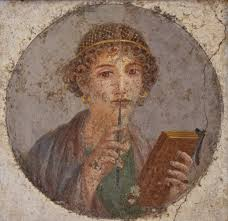 The image is generated through artificial intelligence on the basis of the renowned mosaic housed in the Museo Archeologico Nazionale of Naples. The attribution is uncertain, as some scholars identify the image as the poet Sappho, while others, as the Pythagorean philosopher Theano.